

Table of Contents
Technology is transforming finance faster than ever before. From digital payments to artificial intelligence-driven analytics, tech finance is enabling businesses and individuals to manage money with greater speed, accuracy, and security.
Finance is no longer just about numbers; it is about efficiency, transparency, strategy, and convenience. Whether for daily operations, investment decisions, or long-term planning, technology now underpins almost every financial process.
This article explores how tech finance is transforming the financial world, its benefits, adoption strategies, challenges, and the future outlook for organizations of all sizes.
Definition and Core Concept
Tech finance is the integration of technology into financial services and processes. It includes solutions such as digital banking platforms, automated accounting systems, fintech applications, AI-powered analytics, and blockchain tools. Its main goal is to make financial operations faster, more accurate, and accessible.
Businesses can leverage tech finance for budgeting, payroll, risk assessment, investment management, and real-time financial reporting. Individuals benefit from digital wallets, mobile banking, robo-advisors, and intelligent savings tools.
Why Businesses Need Tech Finance
Maintaining accuracy, transparency, and efficiency in finance is increasingly difficult. Manual processes are time-consuming, error-prone, and expensive. With multiple departments and stakeholders involved, inconsistencies are inevitable without technological support.
Tech finance provides standardized workflows, automated approvals, and real-time visibility. Businesses can manage their finances more strategically while ensuring compliance with local and international regulations.
In an era of rapid digital transactions and globalized commerce, integrating technology into finance is no longer optional—it is essential for staying competitive and agile.
The Benefits of Tech Finance
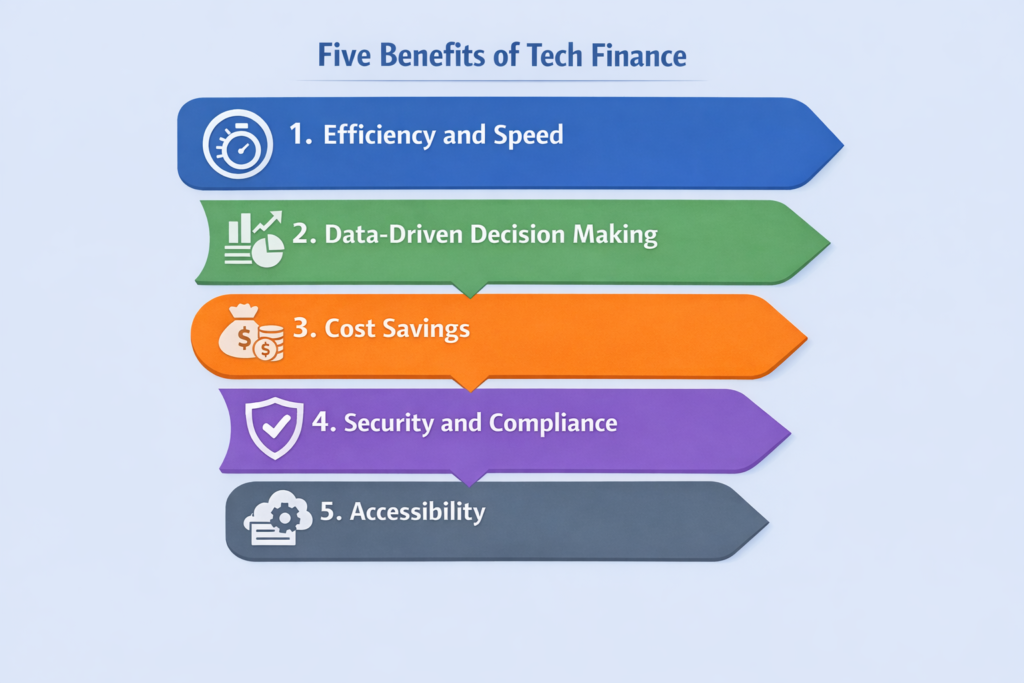
1. Efficiency and Speed
Automation allows processes like payroll, expense reporting, and financial reconciliation to be completed quickly and accurately. For example, AI-driven software can reconcile hundreds of transactions in minutes, a task that would take humans days to complete. This speed not only saves time but also reduces human error, improving overall reliability.
2. Data-Driven Decision Making
Modern financial tools can analyze massive datasets to provide actionable insights. Companies can forecast trends, optimize cash flow, and make investment decisions based on real-time data rather than historical records alone. For example, predictive analytics can identify seasonal cash flow patterns, helping businesses prepare for fluctuations in revenue or expenses.
3. Cost Savings
By automating repetitive tasks and streamlining financial operations, tech finance reduces operational costs. Teams can focus on strategy and analysis instead of manual data entry. Small and medium-sized businesses, in particular, benefit from reduced overhead, while larger organizations gain efficiency at scale.
4. Security and Compliance
Security is a top concern in finance. Tech finance platforms use encryption, fraud detection, and compliance monitoring to safeguard sensitive data. This ensures that financial operations meet regulatory requirements while protecting against cyber threats. Automated alerts notify managers of suspicious transactions, helping prevent losses and maintain trust.
5. Accessibility
Tech finance democratizes financial management. Mobile banking, online investment platforms, and digital wallets allow individuals and small businesses to access financial services without relying on traditional banks. This increases inclusivity, reaching underserved populations while providing greater convenience for all.
Key Technologies Driving Financial Transformation
Digital Payments and Mobile Banking
Digital payments and mobile banking are at the forefront of tech finance. Businesses benefit from instant payments, automated invoicing, and real-time transaction tracking. Consumers enjoy convenience and flexibility, whether paying bills, making purchases, or transferring money globally.
For example, platforms like PayPal, Stripe, and Square allow merchants to accept payments online and offline while integrating with accounting software to track revenue automatically. Mobile apps provide notifications, balance updates, and transaction histories instantly, reducing the need for physical banking.
Artificial Intelligence and Machine Learning
AI and machine learning are transforming financial analysis, customer service, and risk management. Algorithms can detect fraudulent transactions, identify investment opportunities, and predict financial trends. For instance, robo-advisors use AI to provide personalized investment strategies based on individual risk profiles. Chatbots improve customer service by providing instant support and handling routine queries efficiently.
Blockchain and Distributed Ledger Technology
Blockchain technology ensures secure, transparent, and immutable records. It powers cryptocurrencies, cross-border payments, and smart contracts, reducing reliance on intermediaries. Companies can track transactions in real time, improve transparency, and reduce settlement times. For example, supply chain finance benefits from blockchain by providing verified records of invoices and payments between multiple parties.
Five Steps for Adopting Tech Finance in Your Organization
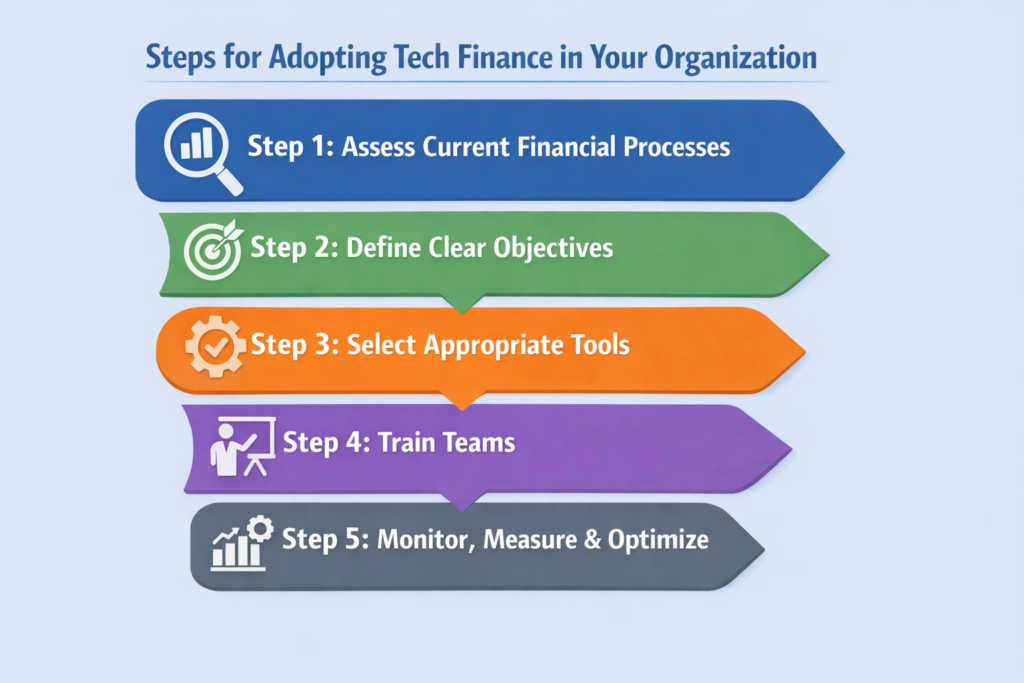
Step 1: Assess Current Financial Processes
Evaluate existing workflows, identify inefficiencies, and prioritize areas where technology will have the most impact. Understanding pain points is key to implementing solutions that truly improve operations.
Step 2: Define Clear Objectives
Set measurable goals for your tech finance adoption. Goals may include faster reporting, reduced manual errors, enhanced customer experience, or improved regulatory compliance.
Step 3: Select Appropriate Tools
Choose platforms that fit your organization’s size, industry, and financial needs. Look for tools with reporting capabilities, workflow automation, and analytics dashboards. Ensure that the platforms integrate with existing systems like ERP, CRM, or accounting software.
Step 4: Train Teams
Employee adoption is crucial for success. Provide comprehensive training on software use, cybersecurity best practices, and data interpretation. Encourage feedback to address issues early.
Step 5: Monitor, Measure & Optimize
Tech finance is an ongoing investment. Track KPIs, analyze performance, and refine processes to improve efficiency and ROI. Automation should be continuously enhanced to adapt to changing business needs.
Factors for Successful Implementation
Integration Across Systems
Automation is most effective when financial tools integrate with accounting, payroll, CRM, and other platforms. This eliminates silos and improves efficiency.
Scalability
Solutions must grow with your business. Choose platforms that can handle increased transaction volume or multiple locations without performance issues.
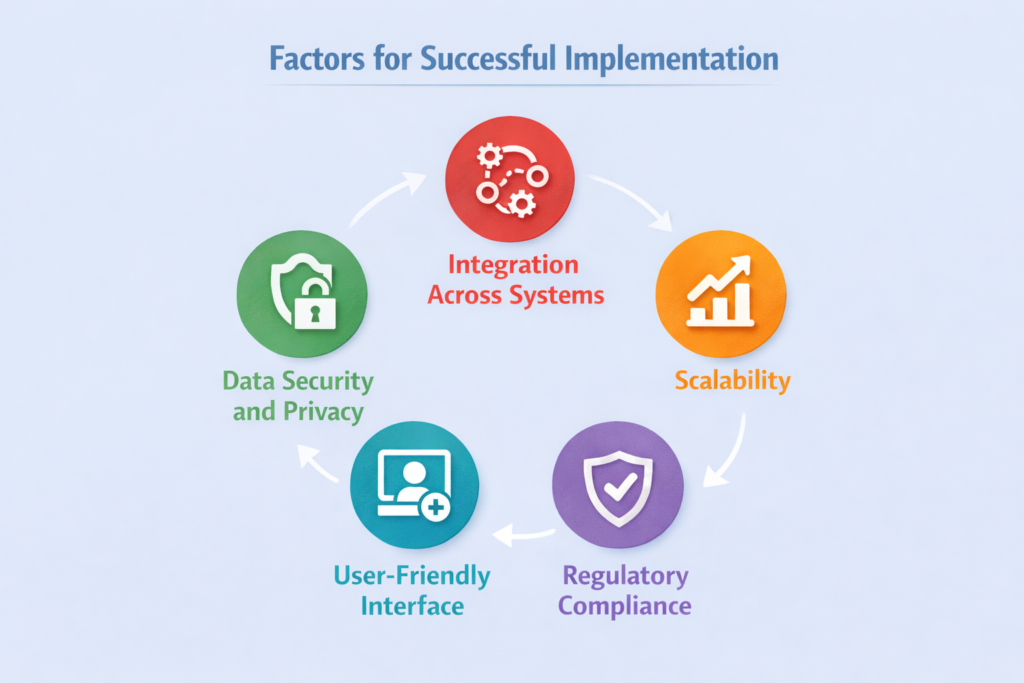
Regulatory Compliance
Ensure technology meets local and global financial regulations. Compliance modules can simplify reporting and auditing.
User-Friendly Interface
The easier a system is to use, the higher the adoption rate and accuracy.
Data Security and Privacy
Secure encryption, multi-factor authentication, and regular security audits protect sensitive financial data.
Enhancing Customer Experience through Tech Finance
Tech finance improves customer experience by providing faster, more reliable financial services. Automated payments, real-time updates, and personalized insights build trust and loyalty.
For example, a customer using a mobile banking app can receive instant notifications, track spending patterns, and access tailored investment suggestions. This convenience, reliability, and transparency strengthen relationships and create a competitive advantage.
Common Challenges and How to Overcome Them
Cybersecurity Threats: Implement strong encryption, firewalls, and staff training to prevent breaches.
Integration Complexity: Select tools that support APIs and seamless integration.
Resistance to Change: Engage teams with clear communication, training, and demonstrations.
Data Privacy Concerns: Be transparent about data use and maintain compliance with regulations like GDPR or PCI DSS.
The Future of Tech Finance
The future of tech finance is intelligent, connected, and customer-centered.
AI-Driven Insights: Predictive analytics will guide investment, credit scoring, and risk management with more accuracy.
Seamless Automation: Businesses will automate payroll, compliance, and reporting to save time and reduce errors.
Blockchain Expansion: Distributed ledgers will increase transparency, efficiency, and security for global transactions.
Embedded Finance: Financial services will be integrated directly into non-financial platforms such as e-commerce or logistics, increasing convenience and reach.
Conclusion
Tech finance is transforming the way businesses and individuals manage money. By leveraging automation, AI, blockchain, and digital platforms, organizations can improve efficiency, enhance decision-making, and reduce costs.
The most successful tech finance strategies combine innovation with simplicity, ensuring accessibility, security, and scalability. Businesses that embrace tech finance strategically will remain competitive, adaptable, and trusted in an increasingly digital financial world.
Frequently Asked Questions (FAQ)
Tech finance is the use of technology to streamline financial processes, including digital payments, AI-driven analytics, blockchain, and automated accounting. It’s essential because it increases efficiency, reduces errors, and improves decision-making.
Technology makes financial management faster, more accurate, and accessible. For businesses, it automates payroll, reporting, and risk assessment. For individuals, digital wallets, mobile banking apps, and robo-advisors simplify money management and investment decisions.
Key technologies include digital payments and mobile banking for fast transactions, artificial intelligence and machine learning for predictive analytics and fraud detection, and blockchain for secure, transparent, and real-time transaction tracking.
Tech finance improves efficiency, reduces operational costs, enhances data-driven decision-making, strengthens security and compliance, and increases accessibility to financial services.